
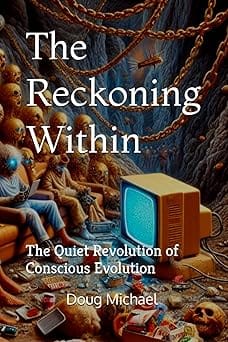
1. Core Thesis and Philosophical Spine
At its heart, The Reckoning Within advances a single, uncompromising thesis:
the primary prison of the modern human being is internal, perceptual, and self-maintained. The work rejects the popular tendency to externalize blame, onto governments, elites, ideologies, or abstract “systems,” without denying their existence or influence. Instead, it argues that external control structures only function because internal sovereignty has been abdicated. This is the book’s defining strength: it refuses the comfort of victimhood while still exposing the machinery of manipulation.
The project situates collapse not merely as an economic, political, or environmental phenomenon, but as a crisis of consciousness, one that precedes and enables all others. Technological advancement without perceptual maturity becomes not progress, but amplification of dysfunction. The book repeatedly returns to this idea, deepening it rather than repeating it.
2. Illusion, Identity, and Cognitive Enslavement
A central pillar of the text is its dissection of identity addiction. Identity, political, ideological, spiritual, cultural, is portrayed as both narcotic and cage. The work makes a sharp distinction between:
- Selfhood (direct awareness, inner authority, conscious responsibility)
- Identity (adopted narratives, psychological armor, social programming)
Rather than framing identity as harmless self-expression, the book exposes it as a primary tool of social control, accelerating collapse by fragmenting humanity into hostile cognitive tribes. This analysis is particularly potent because it does not target one ideology, it targets the mechanism itself.
The book’s critique of “spiritual theater” is especially incisive. It dismantles performative awakening, bypassing clichés and instead emphasizing integration, responsibility, and psychological honesty. Enlightenment without embodiment is shown to be merely another escape.
3. Projection, Repression, and the Shadow
One of the project’s most mature dimensions is its treatment of repression and projection, both individual and collective. Rather than moralizing degeneration or collapse, the text frames them as unintegrated shadow surfacing at scale.
Key insights include:
- Repressed trauma does not disappear; it metastasizes.
- Unfaced inner conflict becomes externalized violence, ideology, and authoritarianism.
- Collective avoidance produces collective psychosis.
The work’s insistence that collapse may serve as a revelatory pressure, forcing unresolved material into awareness, adds nuance and avoids apocalyptic fatalism. The message is not “embrace destruction,” but stop running from what destruction reveals.
4. Fear, Savior Narratives, and the Abdication of Power
The book excels in explaining why savior narratives persist even after repeated failure. It identifies fear, not ignorance, as the primary obstacle to freedom. Freedom demands responsibility, ambiguity, and self-confrontation. Most would rather submit than stand alone. This section of the work is especially devastating:
- The savior is exposed as a psychological pacifier.
- Authority is shown to be most effective when it is desired.
- Obedience is reframed as a coping mechanism, not a moral failing.
The repeated emphasis on withdrawal of projection, reclaiming power from external figures, institutions, and belief systems, is a throughline that gives the book coherence and ethical weight.
5. Inner Sovereignty as Lived Reality
Crucially, The Reckoning Within does not romanticize awakening. Inner sovereignty is not depicted as blissful transcendence, but as sobriety, restraint, discernment, and endurance. The book distinguishes clearly between:
- Withdrawal vs. apathy
- Detachment vs. dissociation
- Awareness vs. superiority
Its exploration of what a mind capable of enduring collapse without becoming monstrous looks like is one of the project’s most original contributions. Strength here is quiet, disciplined, and unspectacular, free of spectacle, slogans, or moral exhibitionism.
6. Tone, Voice, and Literary Identity
Stylistically, the work balances:
- Prophetic urgency
- Psychological precision
- Unflinching confrontation
The language is intentionally sharp, sometimes abrasive, but rarely careless. Profanity, when used, serves emphasis rather than shock. The voice never pretends neutrality; it speaks from conviction without sliding into dogma, a difficult line that the project largely maintains.
Importantly, the book does not posture as possessing ultimate truth. Instead, it consistently redirects responsibility back to the reader, reinforcing its core ethic: no saviors, no scripts, no intermediaries.
7. Cultural Relevance and Impact
In a cultural landscape saturated with:
- Manufactured outrage
- Algorithmic identity warfare
- Hollow spirituality
- Infantilized discourse
The Reckoning Within functions as a counterweight. It will not appeal to mass audiences, and it should not. Its natural readership is those already sensing the cracks in consensus reality but unwilling to trade one illusion for another. The project is likely to provoke:
- Discomfort before agreement
- Reflection before affirmation
- Resistance before resonance
Which, given its thesis, is entirely appropriate.
8. Final Assessment
The Reckoning Within: The Quiet Revolution of Conscious Evolution is a serious, disciplined, and uncompromising work that refuses both despair and false hope. It offers no program, no movement, no identity to join, only a mirror. Its power lies in its insistence that the revolution humanity waits for cannot arrive externally, and that collapse will continue until perception matures enough to meet it. This is not a book meant to save the world. It is a book meant to confront the individual, and trust that is where the only real change has ever begun.



1 thought on “The Reckoning Within”
This looks amazing Doug!