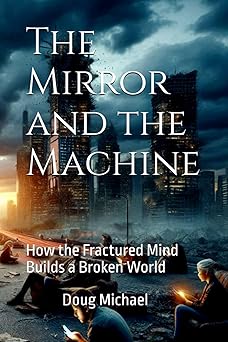
The Mirror and the Machine: How the Fractured Mind Builds a Broken World presents a psychological interpretation of modern civilizational crisis. Its central claim is that contemporary social, political, economic, and technological dysfunctions are not primarily structural failures but reflections of a fragmented human psyche. According to the author, the external world operates as a mirror of collective consciousness, while modern systems act as amplifiers of existing psychological patterns.
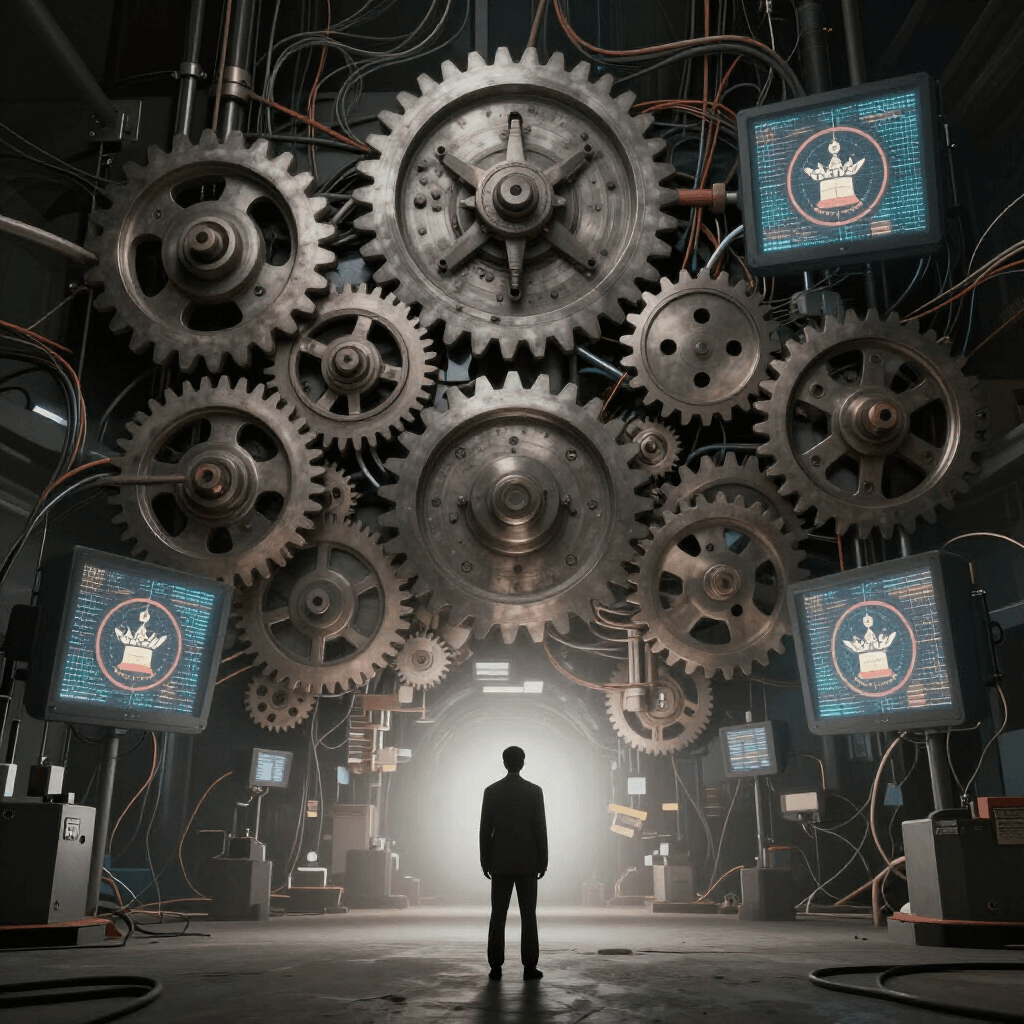
The book argues that humanity possesses unprecedented technological power yet experiences rising anxiety, polarization, institutional distrust, and cultural instability. These conditions are framed as symptoms of internal division, fractured attention, and unresolved psychological conflict within individuals, scaled up through institutions and technologies. The “machine” is defined broadly as the interconnected network of media, financial systems, algorithms, incentives, and governance structures that shape perception and behavior. Rather than creating fragmentation, the machine is said to industrialize and monetize it, reinforcing reactivity, distraction, and tribal identity.
A major theme is the assertion that power in the modern world is primarily psychological. Control is described as operating less through overt force and more through narrative framing, emotional conditioning, dependency, and internalized compliance. The book emphasizes how attention, fear, and identity are leveraged to guide populations, leading individuals to police themselves and one another. Language, symbolism, media, and education are portrayed as tools that shape perception and narrow acceptable thought.
Economically, the author contends that debt‑based fiat monetary systems are structurally unsustainable and nearing collapse. Financial instability is framed as both an outcome of systemic design and a catalyst for further centralization. The transition toward digital and programmable money is presented as a shift that could enable behavioral monitoring and conditional access, with crises used to justify increased control and dependency.
Throughout the book, political polarization and identity‑based conflict are described as mechanisms of division that prevent unified awareness and reinforce existing power structures. The text argues that populations focused on horizontal conflict are less likely to recognize underlying systemic dynamics. Identity politics is framed as a late stage of fragmentation in which tribal allegiance replaces shared humanity and individual discernment.
The concept of the “prison paradigm” runs throughout the work: the idea that the most effective form of control is internal. External tyranny is said to persist because individuals carry unresolved psychological conditioning, internalized authority, and unexamined beliefs. Freedom, in this framework, is not granted by institutions but achieved through self‑knowledge, responsibility, and internal coherence.
A significant portion of the book focuses on shadow integration, the conscious examination of denied fears, impulses, trauma, and contradictions. The author argues that unintegrated inner conflict leads to projection, outrage, and repeated cycles of civilizational collapse. Avoidance, denial, and “toxic positivity” are portrayed as forms of fragmentation rather than healing.
The proposed alternative is the development of the “integrated human”: an individual characterized by psychological coherence, emotional regulation, sovereignty over attention, capacity for nuance, and willingness to stand apart from collective reactivity. Integration is presented as practical and behavioral, not mystical, and as the foundation for any meaningful societal change.
The book concludes that large‑scale transformation does not arise from revolutions, institutions, or mass movements, but from individual shifts in consciousness. When enough people withdraw psychological consent from fragmented narratives and reclaim authorship of their inner lives, systems gradually reorganize. The future, the author suggests, will be shaped quietly by the level of psychological integration humanity is willing to sustain.
Doug Michael is an independent writer and philosophical thinker exploring the unseen forces shaping modern civilization. His work examines the psychological roots of cultural crisis, technological acceleration, and spiritual disconnection, arguing that the outer world is a direct reflection of the inner one.
Across his previous books, he has traced the fault lines of the modern mind and the systems it unconsciously constructs. The Mirror and the Machine represents the most distilled expression of that inquiry yet, a call toward integration in an age of fragmentation.