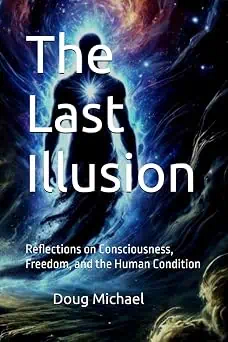
The Last Illusion is a philosophical exploration of consciousness, perception, psychological conditioning, and the forces that shape the human experience. At its core is the idea that much of what we consider reality is filtered through an internal perceptual framework constructed over a lifetime of conditioning, experience, belief, trauma, social influence, and identity.
The book begins by examining the increasingly turbulent world around us and asking whether the chaos we witness externally may also reveal something about the collective human psyche. Rather than simply pointing fingers at external systems, The Last Illusion turns the investigation inward, exploring the relationship between the outer world and the unresolved divisions within human consciousness.
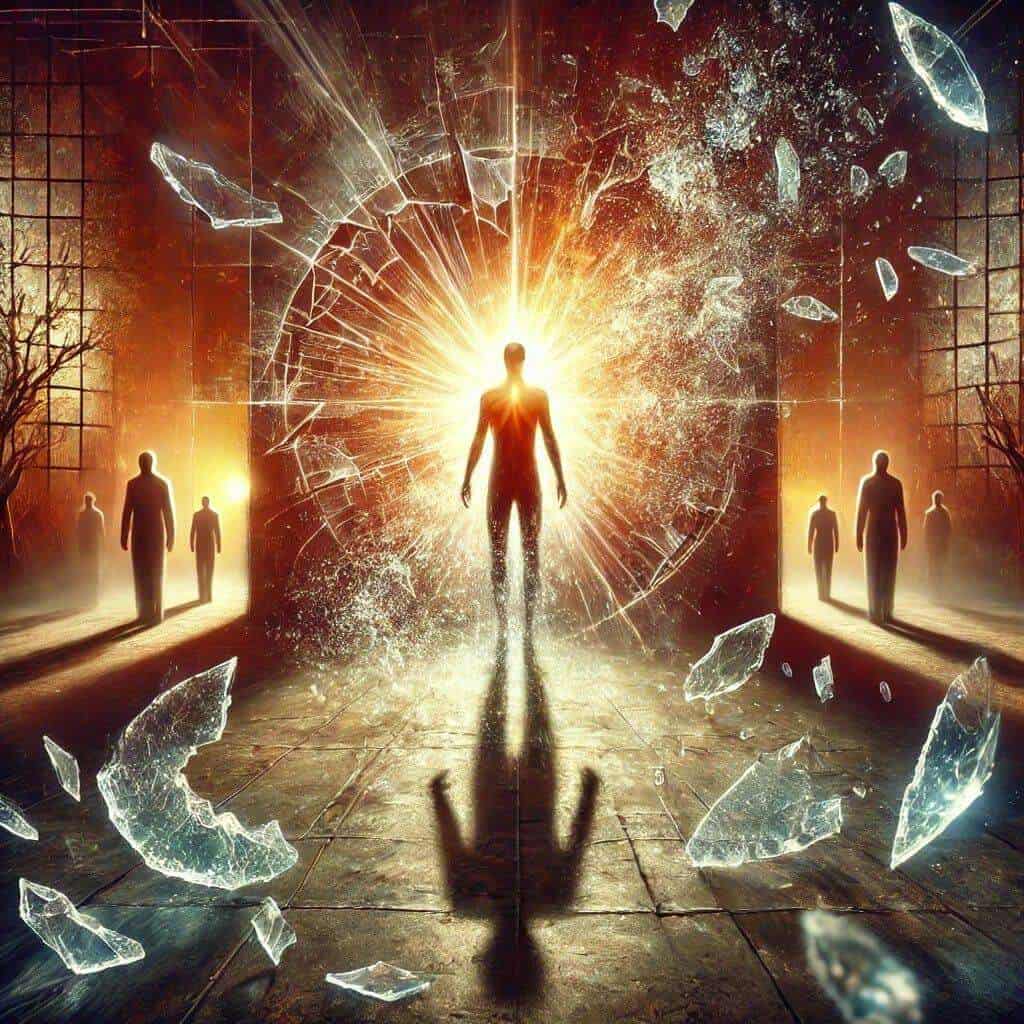
A central theme is the cognitive fortress, the psychological structure we construct around our beliefs and identities. These fortresses provide familiarity and security, but they can also prevent us from questioning assumptions that may no longer serve us. The book explores how individuals can become prisoners of their own perceptions while simultaneously defending the very structures that confine them.
From there, the journey moves into the deeper territory of the psyche: the ego, the shadow, repression, trauma, duality, and the inner schism that develops when opposing aspects of ourselves remain unreconciled. The Last Illusion challenges the idea that genuine spiritual or psychological growth can be achieved through simply ignoring negativity. Instead, it argues for confronting the darkness, making the unconscious conscious, and integrating the fragmented aspects of the self.
The book also examines modern culture’s increasing dependence upon distraction, technology, external validation, and collective consensus. It questions what happens when technological advancement accelerates faster than psychological and spiritual development, and considers the possibility that humanity’s greatest limitation may not be a lack of information, but an unwillingness to examine the assumptions through which that information is interpreted.
Throughout the work, recurring metaphors—the hall of mirrors, the stormy sea, the ship, the perceptual overlay, the cognitive fortress, and the silent witness, illustrate the journey from unconscious participation toward greater self-awareness.
Ultimately, The Last Illusion is not an argument for withdrawing from the world, nor is it an attempt to replace one rigid belief system with another. It is an invitation to engage in the difficult process of deconstruction and unlearning: to question inherited beliefs, examine the ego, confront the shadow, reconcile the inner divide, and discover what remains when the layers of conditioning begin to fall away.
The book concludes with a simple but profound possibility: perhaps liberation does not require us to become something we are not. Perhaps it requires us to remember what has been obscured beneath everything we were taught to believe ourselves to be.
The journey outward has always been accompanied by a journey inward. And when the fortress finally falls, the individual may discover that the key to freedom was never outside the walls, it was within.